
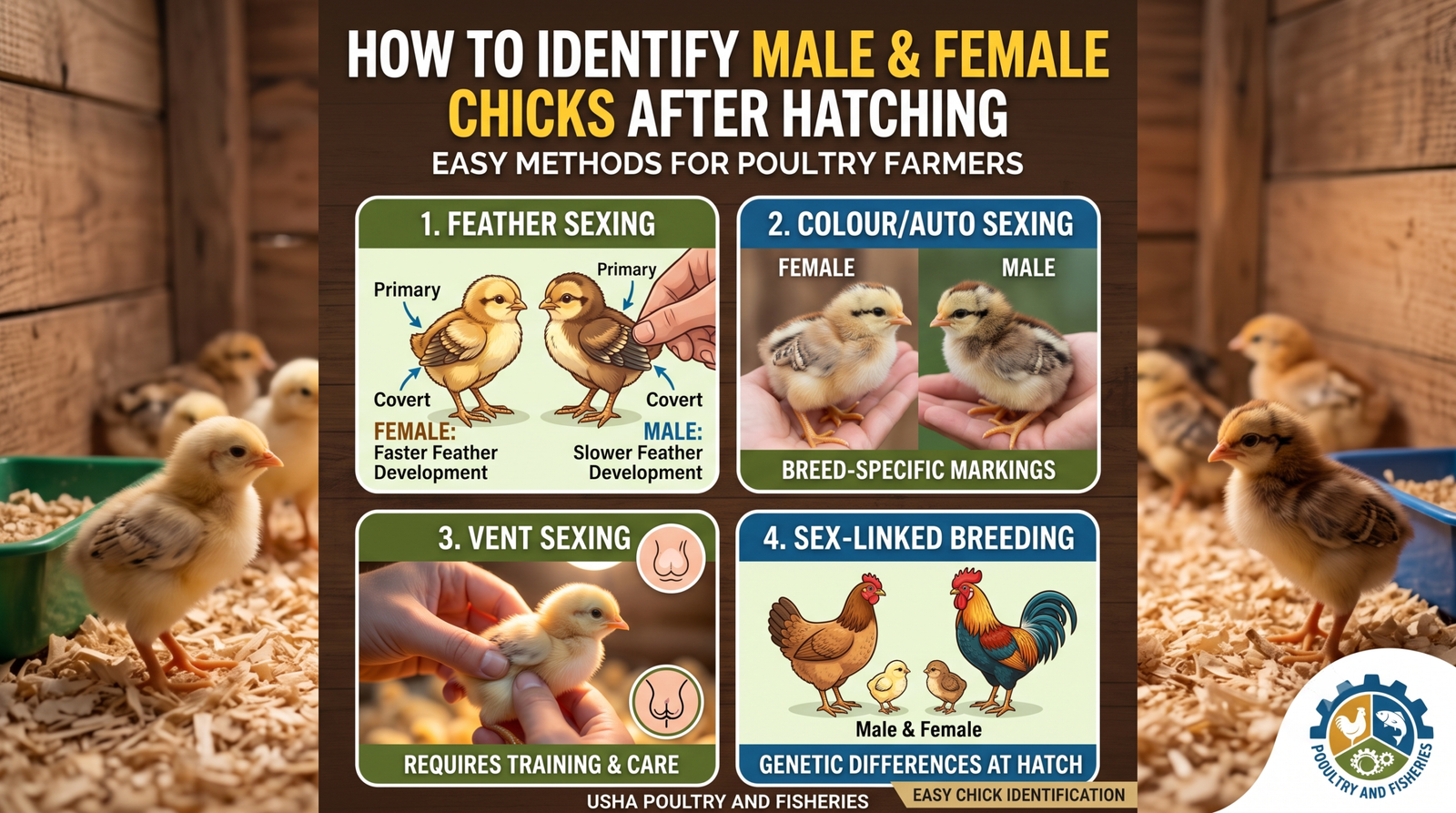
Identifying whether a newly hatched chick is male or female can be important for poultry farmers, backyard chicken keepers and hatchery operators. Knowing the sex of chicks helps farmers plan their flock, feeding, housing and future breeding strategy.
However, it is important to understand that there is no single visual method that works accurately for every chicken breed. The most reliable method depends on the breed or strain, genetics and the purpose for which the chicks are being raised.
In this guide, we will explain some commonly used methods for identifying male and female chicks after hatching.
1. Feather Sexing
Feather sexing can be useful in certain chicken strains where the genetics have been specifically selected to produce differences in early feather development.
When the chick is only a few days old, carefully examine the wing feathers.
In some sex-linked strains:
- Female chicks may develop primary feathers more quickly.
- Male chicks may have slower feather development.
- The difference can sometimes be observed by comparing the length and arrangement of the primary and covert feathers.
Important
Feather sexing does not work reliably for every breed. It should only be used when you know that the particular strain has been bred for feather-sexing characteristics.
2. Colour Sexing
Some commercial chicken strains are genetically designed so that male and female chicks have different colours or patterns at hatch.
This is known as autosexing or colour sexing.
For example, certain strains may show differences in:
- Head markings
- Back stripes
- Body colour
- Wing colour
- Overall down pattern
These differences can make it possible to identify male and female chicks soon after hatching.
However, this method depends heavily on the specific breed and genetics.
A colour difference seen in one breed cannot automatically be used to identify chicks of another breed.
3. Vent Sexing
Vent sexing involves examining the chick’s cloacal area to identify anatomical differences.
It is one of the techniques used commercially for day-old chick sexing, but it requires proper training and experience.
An inexperienced person should not attempt vent sexing because incorrect handling can injure a very young chick.
For commercial hatcheries, trained chick sexers can achieve high accuracy with appropriate training and suitable breeds.
For small farmers and backyard poultry keepers, this is generally not the easiest method to perform at home.
4. Behaviour and Body Shape — Don’t Depend on This at Hatch
Farmers sometimes try to identify chicks based on:
- Size
- Activity
- Leg thickness
- Head shape
- Beak shape
- Standing posture
- Aggressiveness
These characteristics may sometimes appear different as chickens grow, but they are not reliable methods for determining the sex of a newly hatched chick.
A larger or more active chick is not necessarily a male.
Similarly, a smaller and quieter chick is not necessarily a female.
Therefore, avoid making important flock decisions based only on these observations.
5. Sex-Linked Breeds and Crosses
One of the most practical approaches to producing easily identifiable male and female chicks is to use sex-linked or autosexing breeding programmes.
In these birds, particular genetic combinations produce visible differences between male and female chicks at hatch.
This is particularly useful for hatcheries because farmers can identify chicks without requiring complicated testing.
However, the exact method depends on the parent lines used to produce the chicks.
What About Broiler Chicks?
Most commercial broiler chicks are not designed to be visually sexed simply by looking at them immediately after hatching.
Male and female broilers can look extremely similar when they are one day old.
Some commercial operations may separate sexes using specialised methods, but ordinary farmers should not assume that a visual difference means a chick is male or female.
What About Sonali and Desi Chicks?
For Sonali, desi and other backyard-type chickens, identifying the sex immediately after hatching can be difficult.
As the birds grow, differences may become easier to observe.
Depending on the particular strain, males may eventually develop:
- Larger combs
- Faster comb development
- Thicker legs
- More prominent body structure
- Pointed saddle and hackle feathers
- More pronounced tail feathers
- Male-specific plumage
Females generally develop a smaller comb and a different body and feather profile.
But these characteristics become more useful as the chicks grow, rather than immediately after hatching.
At What Age Can You Identify the Sex More Easily?
The answer depends on the breed.
For some genetically sex-linked birds, identification can be possible immediately after hatching.
For ordinary chickens, reliable identification may become considerably easier after several weeks.
By around 6–12 weeks, differences in comb development, feathering, body structure and behaviour can become much more noticeable, although the exact timing varies between breeds.
By sexual maturity, identification is usually much easier.
Don’t Confuse Sex Identification With Breed Identification
A common mistake among new poultry farmers is to assume that every chick with a particular colour or body shape belongs to a particular sex.
This is not necessarily true.
Chick appearance can be influenced by:
- Breed
- Parent genetics
- Crossbreeding
- Age
- Nutrition
- Incubation conditions
- Individual variation
Therefore, always consider the breed and genetic background before using a chick-sexing method.
Practical Tips for Farmers
If you have recently hatched chicks, follow these simple steps:
- Identify the breed or strain first.
- Check whether the strain is known for autosexing or sex-linked characteristics.
- Use feather or colour sexing only when the method is known to work for that strain.
- Don’t depend on size, activity or behaviour alone.
- Avoid attempting vent sexing without proper training.
- Keep accurate records if you are operating a hatchery.
- When accuracy is commercially important, use an experienced professional or an appropriate genetic/testing method.
Final Conclusion
There is no universal trick for identifying male and female chicks immediately after hatching.
The most practical method depends on the chicken’s genetics. Some breeds and crosses can be identified through colour or feather characteristics, while others require trained vent sexing or waiting until the birds develop clearer secondary sex characteristics.
For poultry farmers, the most important first step is therefore to know the breed and parent line of the chicks before choosing a sex-identification method.
If you are raising broilers, Sonali, Gavran or backyard chickens, proper identification can help you plan your flock more efficiently and make better decisions about feeding, housing and future breeding.
Follow Usha Poultry and Fisheries for more practical information about poultry farming, chicken breeds, feeding, disease prevention, hatchery management and fisheries.